Is Substack poaching the Instagram intelligentsia?
On intellectual capital flight and the Substack migration

Thinking is ‘in’
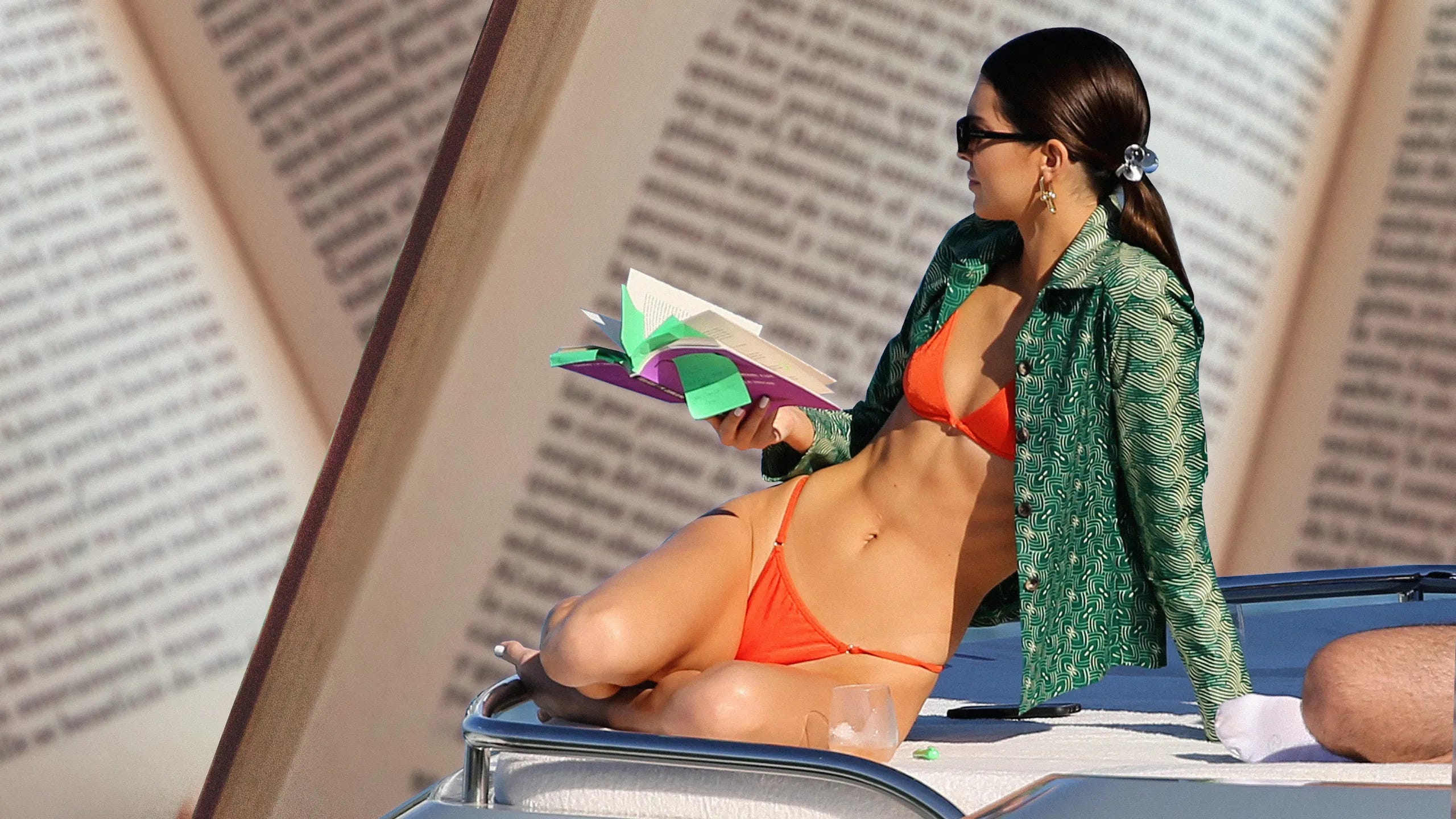
I truly don’t think I’m committing a sampling bias when I say the Smart Kids are all getting on Substack. Does this sound pretentious? That’s okay. I use Smart Kid to refer to anyone who identifies with cognitive exercise as part of their digital identity, whether or not they are actually smart (hell if I know I am). But the internet seriously has a thing for thinking right now! Reading books is now ‘hot’ (see Kendall Jenner: patron saint of alternative literature). Writing is now cool (the cultural watershed of 2025 was Charli getting on Substack). The mass adoption of this app applies to literary Instagram, at least, with every creator worth their salt looking to fatten up their content stream with a newsletter launch. It’s horizontal diversification, and a clever business strategy for creators looking to anchor their following.
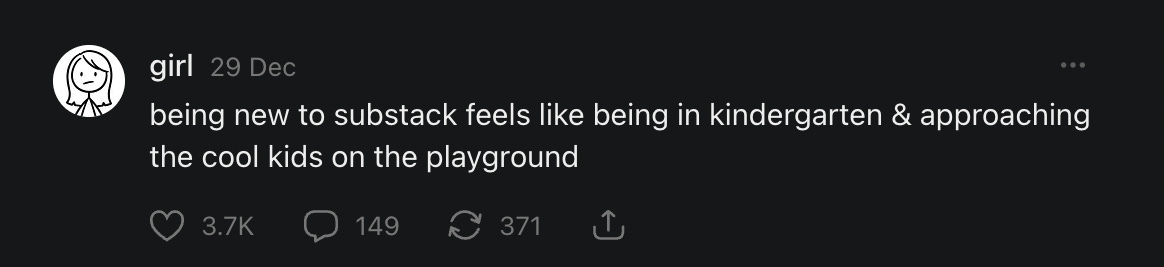
Capital flight describes the movement of assets out of a home economy due to dwindling confidence in the latter. I’d riff on this and say that the internet’s intellectual capital is certainly not exempt from this phenomena—the content posted by your journalists, cultural critics, tastemakers, novelists, academics, historians, and what have you; content that relies on written word instead of visuals, on cognitive depth instead of instant gratification.
The intellectuals on Instagram may not be fleeing their home app altogether, but they are certainly looking abroad. Especially with the way the platform has changed over the years. It’s hard for something analytical to find an audience on Instagram now that reels are the primary vector of discovery instead of traditional written posts. Add to that the loss of hashtags, their power to cluster and spotlight content. Not to mention the increased ad load that has turned every few Instagram posts on your dashboard into a sponsored piece or plain payola, displacing content from people you actually follow.
If you’re an Instagram vet like me, you are not alone if you think the platform is getting worse—I will be the first to declare that the arc of social media bends towards decay. Every social media platform gets enshittified by design, as the theory goes. It’s how they keep the tech giants fed.
The Platform Life-Cycle and Substack’s Promise
The enclosure of the commons is probably the #1 recurring trope in Western history—the pastures in feudal Britain, the seas post-WWII, now the digital commons by corporate elite. Every digital commons starts off free, offering value to end-users while the tech firms themselves operate at a loss. This typically comprises the “good old days” of the platform in question, the time when it is cleanest, most user-friendly, and feels most like a pure community forum. Once enough users become reliant on this product, however, the company then moves to enclose the commons, squeezing value back to itself—TikTok now encourages creators to pay to be viral; Amazon now makes retailers pay to optimise search; Meta requires people to pay to opt out of providing user data (“Choose whether or not to share your data”… it is not a real choice if one of the options requires payment, Mark!)
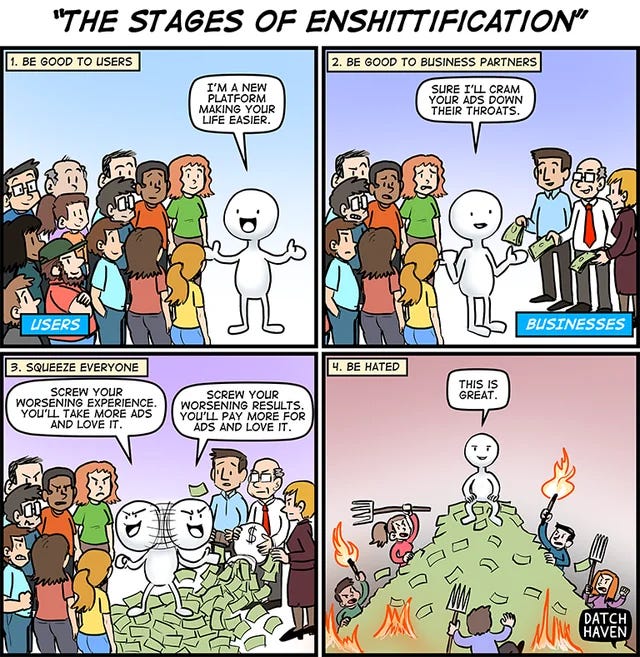
These are the moves that are subtly shifting user value back to corporate and are filling these ‘free community forums’ with payola and useless information. It’s a classic bait-and-switch business model, and Big Tech loves it. In a sense I don’t know how much power us end-users even have in contributing ideas to the forum at all; at my most cynical, I feel like these platforms are basically corporate cash cows disguised as community marketplaces. For more on this see Corey Doctorow’s piece in WIRED—he is one radicalizing dude and I’m thankful.
Against this context, I hope you can see that Substack is not just a trendy second home for the world’s “thought daughters” and “lit girls”, but a powerful means for all writers and readers to set boundaries with the internet, like a sort of communication revolution in miniature. Substack broke onto the market in 2017 with a bold proposition: to bring back internet communication that puts users first. On Substack, you possess what is essentially a personal newsroom. You have full ownership of your audience. Your words reach people without an algorithm as an intermediary. Best of all, the platform prizes long-form written content instead of reactive, visual media. As the company itself wrote:
The great journalistic totems of the last century are dying. News organizations—and other entities that masquerade as them—are turning to increasingly desperate measures for survival. And so we have content farms, clickbait, listicles, inane but viral debates over optical illusions, and a “fake news” epidemic. Just as damaging is that, in the eyes of consumers, journalistic content has lost much of its perceived value—especially as measured in dollars.
It’s easy to feel discouraged by these dire developments, but in every crisis there is opportunity. We believe that journalistic content has intrinsic value and that it doesn’t have to be given away for free. We believe that what you read matters. And we believe that there has never been a better time to bolster and protect those ideals.
For what its worth, Substack’s team really does seem committed to creator-centric growth. It is an independent company held by private investors, at least for now. It is putting customer engagement over profit. It is a crucial testbed of what could redefine the future of work: a labour market where individuals build livelihoods by monetizing their own passions, sustaining their self-employment through fanbases and internet niches in a model that Li Jin calls the “passion economy”.
And then there’s the direct-to-inbox feature. On places like Instagram and Twitter, it’s hard to salvage your internet community if the platform leaves you dry. There is nothing to protect our ‘end-to-end’ rights—the principle that networks should deliver speakers’ messages to listeners as quickly and reliably as possible. (Instead, our communication is hijacked midway by an algorithm or by TikTok offering a price to break you out of shadowban jail). If one of these platforms flatlines, its communities are broken and scattered to infinite reaches of the web. Substack, meanwhile, ensures that creators always directly reach whoever has subscribed to read. In this sense a content drop feels more meaningful—building relationships rather than monetising attention. It feels like I am dignifying your time with ideas that I actually took care to compose, and it feels like I am building connections to last.
The future of Substack, of course, is still an open question. Features like the Substack app, Substack ‘likes’, the Substack social feed, etc., are starting to mimic Instagram in ways that the working writer might not appreciate. Substack Notes grinds my gears in particular. It seems counterintuitive to the mission of fostering long-form journalistic rigour if creators now have the option of using Substack like X/Twitter, to hack the Substack internal FYP with pithy remarks of their superior aesthetic judgment. As the app grows, I really don’t want it to become another data grab or rat race in vanity stats. If we fled Instagram just to come doomscroll down another content corridor, then what’s the point, you know? (Speaking of X, Elon Musk also tried to buy Substack, which is a future too dark to contemplate. I don’t want this platform to be another tragic victim in the Big Tech cycle of autocannibalizing its own creations.)
I get that the point of Notes is to give smaller writers a chance to be discovered. This platform makes it hard to connect with new readers other than the ones who already know you, because of Substack’s model as a software-as-a-service (SaaS). SaaS tools allow creators to own their audience data instead of renting it from the tech stack, but this means the readership isn’t built into the platform itself. Writing on a marketplace like Medium, in contrast, relies on the platform’s existing customer base and takes the pressure of audience recruitment off the writer. But let’s say that a grassroots writer gets big on the Substack FYP through Notes—even in this case, I doubt users on the receiving end will actually linger on the author’s profile and explore it properly. Chances are, they’ll just doomscroll to the next Note.
We can still be smart on Instagram
Every so often, I see a writing post blow up on Instagram and it fills me with comfort. For almost a year now, I’ve been fading in and out of literary Instagram in a passion of inactivity. So have most of my creator friends, which is why I get a little arrest of relief whenever the subculture shows itself alive and kicking. My inactivity is possibly out of laziness but also because I really don’t want to say things when I don’t have something to say. I know quantity drives growth, but I also don’t want to compromise quality, and right now I’m not in a place to have both.
This attachment to quality is definitely unstrategic but it comes from a deeper conviction: I don’t want to give up on Instagram just yet. I like the people I’ve met. I think they like me, and I want to honour their attention by putting the work into what I release. I’m cheered by the comeback of carousel posts on Instagram—maybe 2026 really is the new 2016. Every time I post for the user community and not for some SEO it is like negotiating some of my value back from the shareholders that Big Tech is squeezing it towards. Rigour is radical! Wherever you are, I would say keep on quality-proofing your posts. Keep up the production value through the payola. We can keep one foot on Substack and the other on the pivot, I think. Smart is the new dumb, after all, and brains are ‘in’.
tbh, as someone who grew up without social media, I kinda feel like an alien watching the way people act and engage with others on platforms like Instagram. just the way everyone seems a slave to the mystical Algorithm and the pursuit of growth. idk, it's like religion to me, you can explain it but I'll never get it.
I do think part of what makes social media enticing is that it can seem like reality. notes and Instagram stories feel like casual shower thoughts and moments in the life. it looks authentic—and people like that, I guess. things are relatable. you can curate a feed that makes you feel seen and validated, but there is little space for genuine engagement when it’s all so short. longform posts like on Substack not only provide a space for the writer to articulate their own views, but for readers to as well, in a space that values productive conversation.
thank you for this post! such a fascinating analysis of Substack and other platforms. I’ve been thinking about some of these lines of thought but didn’t have the knowledge or vocabulary to articulate it like you do.